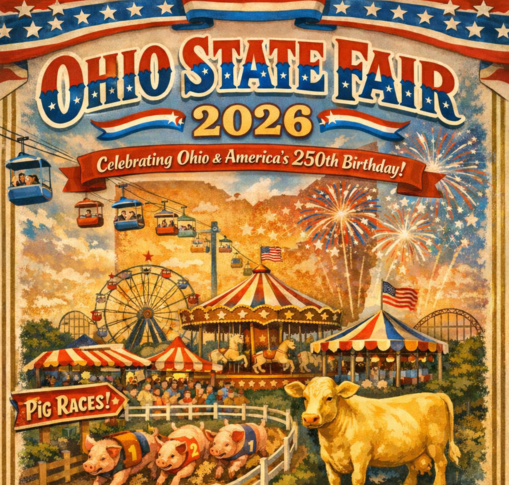
As fair season winds down and we recover from the fun and fried food, one topic still has people talking: the Ohio State Fair Poster Contest winner.
The competition is a newer concept that the Ohio State Fair launched in 2024. At the time, artificial intelligence (AI) was nowhere near as developed or widely used as it is in 2026. Now, a simple prompt can generate videos, photos and designs in seconds.
This year, an AI-assisted design took home the contest’s top prize. The poster, created by Westerville resident Christin Billips, was selected as the grand champion and earned a $1,000 prize. The use of AI was disclosed as part of the application process and was permitted under the contest’s rules.
But the win quickly sparked pushback. Artists and fairgoers questioned whether AI-generated work should compete alongside artwork created through more traditional methods, with much of the debate centering on creativity, fairness and what it means to recognize artistic skill.
The reaction was strong enough to prompt a change.
The Ohio State Fair has since announced that it will reevaluate the poster contest’s rules and processes for 2027, including prohibiting the use of AI.
“We are committed to celebrating Ohio artists, with a number of other competitions that don’t permit AI, including the fine arts exhibition, creative arts competitions, mural contest, and plein air painting,” the Ohio State Fair said.
The controversy raises a bigger question for those of us who work in creative fields: What do we lose when we take the human out of the creative process?
AI has become an incredible tool and certainly has its place, but it can’t replace the experience of working closely with a graphic designer who takes the time to understand your vision, audience and the story you want to tell.
Celebrating artists – especially local artists – and their craft is integral to our industry. Creating design that communicates, connects and feels authentic comes from conversation, collaboration and trust.
And sometimes, a client doesn’t know exactly what they want. That’s part of the process.
Great designers know how to listen, ask the right questions and uncover details or ideas a client may not have considered – or may simply have a hard time putting into words. From there, they translate those conversations into visuals that reflect a brand’s personality, purpose and audience.
The design process is a partnership. AI allows for quick generation, but it doesn’t provide the thoughtful decision-making and back-and-forth that comes from refining an idea with another person. Conversations with a human designer add depth and meaning to the final work, creating a design that feels intentional rather than simply generated.
For decades, our design team at MurphyEpson has seen the value of that human-centered approach firsthand. Great design often starts before a client can fully articulate what they’re looking for. Our designers are part artists, part strategists and part psychologists – asking questions, reading between the lines and helping clients uncover ideas they may not have known how to express.
Through conversation, exploration and back-and-forth, we turn those ideas into visuals that feel right, even when the client couldn’t quite describe what “right” looked like at the start.
It’s an approach that has helped our work earn industry recognition, including PRSA Central Ohio PRism Awards, while creating work that is thoughtful, intentional and distinctly our clients’ own.
That’s the part of the process AI can’t replicate.
AI can produce impressive visuals in seconds, but it doesn’t understand your goals, build off your successes or recognize the subtle details that make your organization unique. It doesn’t know when something technically checks all the boxes but still doesn’t feel right.
A human designer does.


